Regrettably, light pollution in Malta and Gozo is widespread, and there are only a few sites on both islands where the night sky is good for astronomical observations.
This image was taken from Mellieha where the northern sky is fairly dark but the southern and southeastern parts are flooded with light. Image taken on 12 August 2020. The bright ‘star’ at top left is the planet Jupiter.

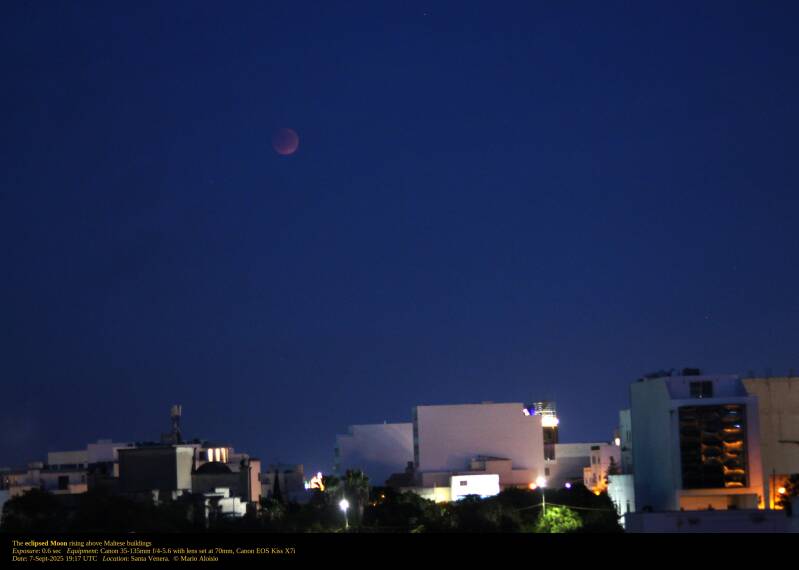
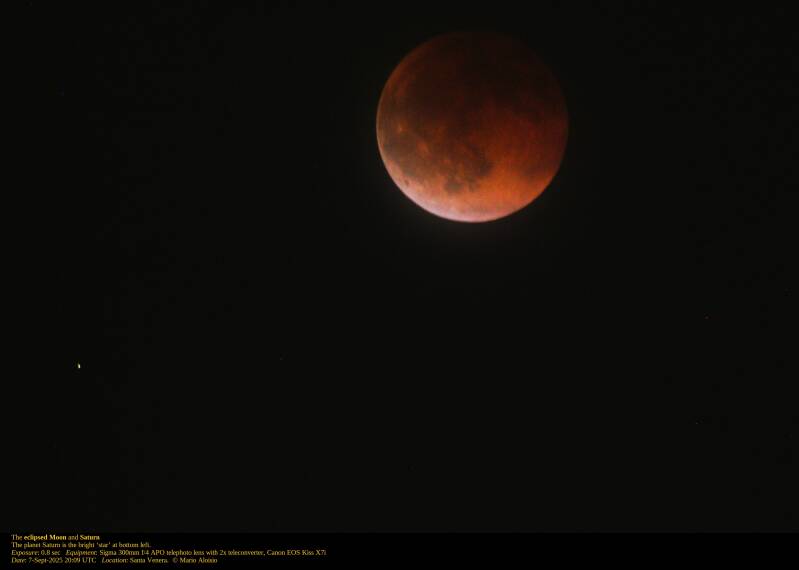
The lunar eclipse of 7 September 2025. The first image shows the eclipsed Moon rising above Maltese buildings. The second image shows a close-up of the eclipse in conjunction with Saturn (the ‘star’ at bottom left). Taken from my home in Santa Venera.
The bright double star Albireo (β Cyg) in the constellation of Cygnus is a spectacular sight in a small telescope, particularly owing to the contrasting colours of the individual stars. These colours are an indication of the surface temperature of the stars, with blue signifying the highest temperatures. Image taken through a 150mm f/5 Newtonian on 10 August 2020.

The ‘beaver’ supermoon of 5 November 2025.
A supermoon occurs when a full moon is at its closest approach to us (and hence appears slightly bigger than usual). The moon’s orbit being elliptical, its distance from the Earth varies so that if the lunar full phase happens to coincide with when the moon is roughly at perigee (the closest distance), then a supermoon is said to occur. Supermoons are common, happening about three times yearly.
This image was taken with a Sigma 300mm f/4 APO telephoto lens and a 2x teleconverter attached to a Canon EOS Kiss X7i camera.
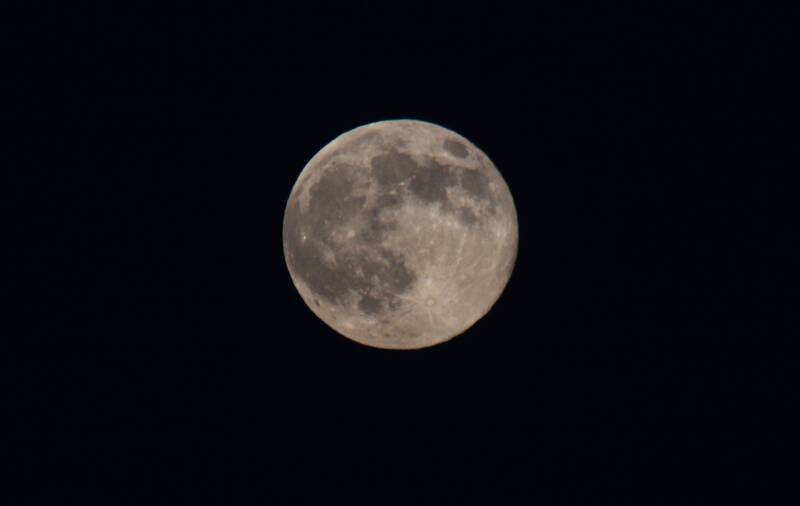
The next image is a photomontage of two images. The moon on this date actually rose north of the church steeple, as can be seen in the third photograph taken on the same date and at the same time with a mobile phone.


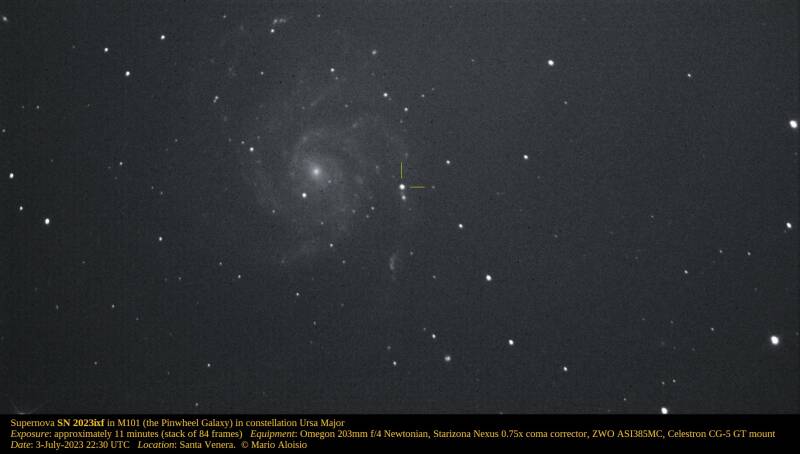
Supernova SN 2023ixf in the Pinwheel Galaxy (M101) in the constellation of Ursa Major.
This supernova was discovered on 19 May 2023 by Koichi Itagaki and had a magnitude of 14.9 at the time of discovery.
The image shown here was taken on 3 July 2023.
Note:
A supernova is typically a very massive star (many times bigger than the Sun) that has come to the end of its life and ‘explodes’ violently after the star’s core has undergone a sudden collapse as a result of it being unable to produce sufficient energy from fusion to counteract the star’s own gravity. The star ejects a huge amount of matter and brightens considerably at first (hence is seen as a ‘super new’ star), then fades gradually.
Nova Lupi 2025 (V462 Lupi) in the constellation of Lupus.
This nova was discovered by the All Sky Automated Survey for Supernovea (ASAS-SN) on 12 June 2025. At the time of discovery, its apparent visual magnitude was 8.7 and within one week it had brightened to magnitude 5.7. The event was classified as a classical nova outburst.
Image taken on 27 June 2025.

Note:
A classical nova consists of a close binary star system which brightens up when matter from the ‘donor’ star (typically a stellar giant) is pulled away by a dense hot white dwarf star to create an accretion of shallow material. This ‘atmosphere’ (consisting mostly of hydrogen) is heated up by the white dwarf, eventually reaching a critical temperature when ignition of a rapid runaway fusion nuclear reaction is started which expels the amassed matter into interstellar space.
Create Your Own Website With Webador