Comets
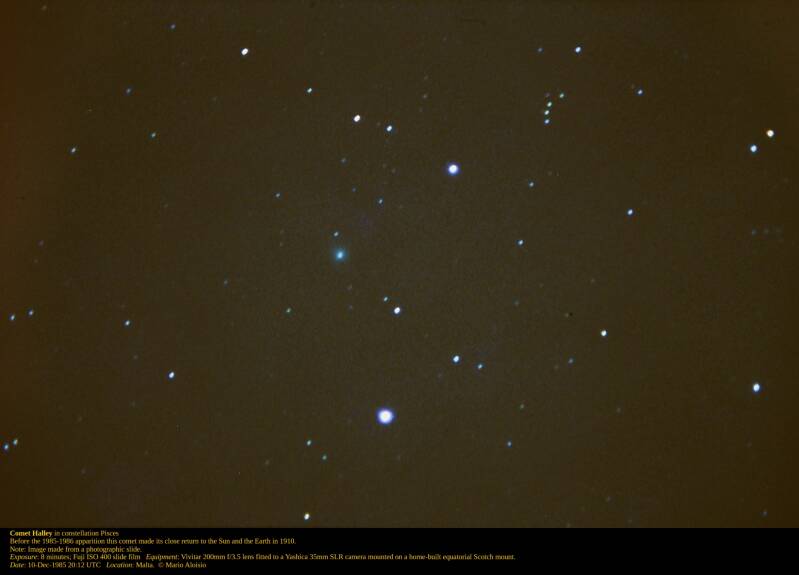
The first image shown here is that of Comet Halley in the constellation of Pisces.
This is the famous comet named after Edmund Halley who in 1696 determined that the bright comets observed in 1531, 1607, and 1682 were in fact one and the same comet that was periodic with a very elliptical orbit and had a period of approximately 76 years (i.e., takes 76 years to make one orbit round the sun). Some of us were lucky enough to witness its return in 1985-1986.
Comet Halley in constellation Pisces
Before the 1985-1986 apparition this comet made its close return to the Sun and the Earth in 1910.
Note: Image made from a photographic slide.
Exposure: 8 minutes; Fuji ISO 400 slide film Equipment: Vivitar 200mm f/3.5 lens fitted to a Yashica 35mm SLR camera mounted on a home-built equatorial Scotch mount.
Date: 10-Dec-1985 20:12 UTC Location: Malta. © Mario Aloisio
The next five images are those of comet C/2020 F3, better known by its common name of NEOWISE. It was discovered on 27 March 2020 during the NEOWISE mission of the Near-Earth Object Wide-field Infrared Survey Explorer (NEOWISE) space telescope. The comet was then an 18th-magnitude object (very faint), located 2 AU (300 million km) away from the Sun and 1.7 AU (250 million km) away from Earth.
Comet NEOWISE became famous for its relative brightness, having achieved an apparent magnitude close to 0.5 in July 2020, shortly after perihelion, and therefore sufficiently bright to be visible with the naked eye. NEOWISE was the brightest comet in the northern hemisphere since 1997 when Comet Hale–Bopp made its appearance. For observers in the northern hemisphere, the comet could be seen on the north-eastern horizon at dawn and, later, on the north-western horizon at dusk.
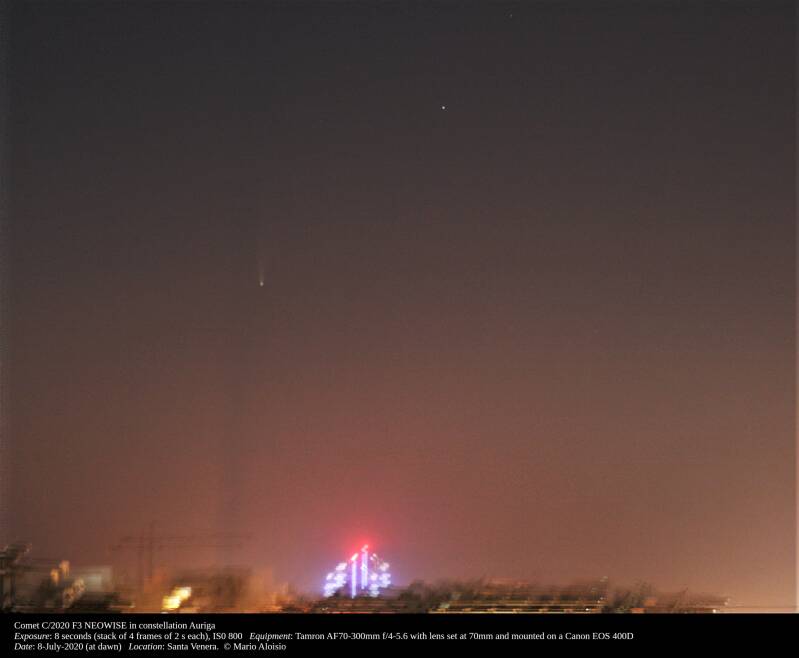
The first image shown here is a stack of four short exposures taken on the early morning of 8 July 2020 from my light-polluted home town of Santa Venera. The prominent lit-up building is the Gzira tower.
Comet C/2020 F3 NEOWISE in constellation Auriga
Exposure: 8 seconds (stack of 4 frames of 2 s each), IS0 800 Equipment: Tamron AF70-300mm f/4-5.6 with lens set at 70mm and mounted on a Canon EOS 400D
Date: 8-July-2020 (at dawn) Location: Santa Venera. © Mario Aloisio
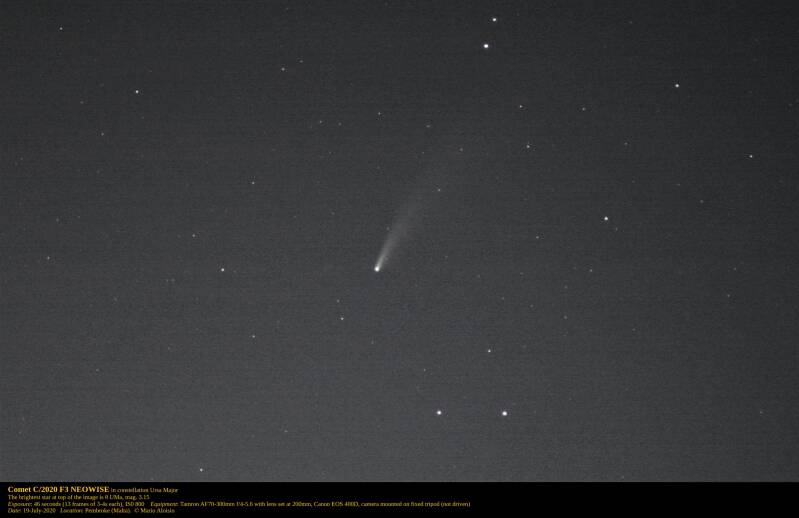
Comet C/2020 F3 NEOWISE in constellation Ursa Major
The brightest star at top of the image is θ UMa, mag. 3.15
Exposure: 46 seconds (13 frames of 3-4s each), IS0 800
Equipment: Tamron AF70-300mm f/4-5.6 with lens set at 200mm, Canon EOS 400D, camera mounted on fixed tripod (not driven)
Date: 19-July-2020 Location: Pembroke (Malta). © Mario Aloisio
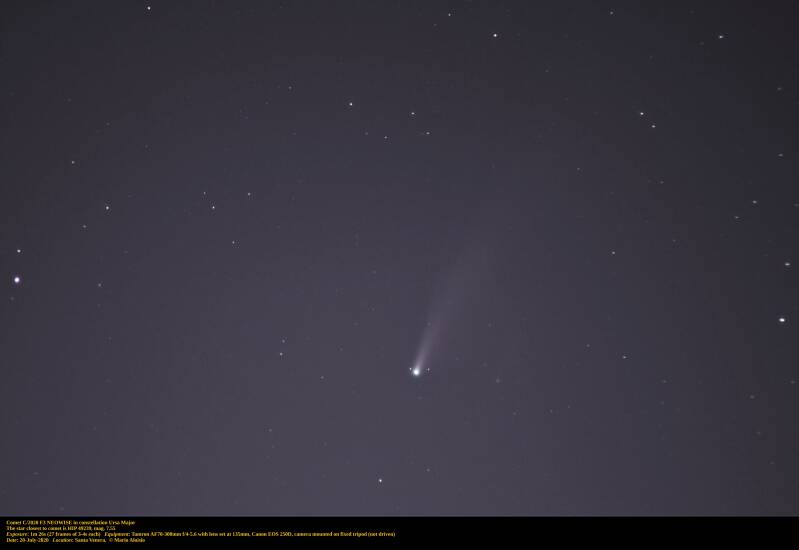
Comet C/2020 F3 NEOWISE in constellation Ursa Major
The star closest to comet is HIP 49239, mag. 7.55
Exposure: 1m 26s (27 frames of 3-4s each) Equipment: Tamron AF70-300mm f/4-5.6 with lens set at 135mm, Canon EOS 250D, camera mounted on fixed tripod (not driven)
Date: 20-July-2020 Location: Santa Venera. © Mario Aloisio
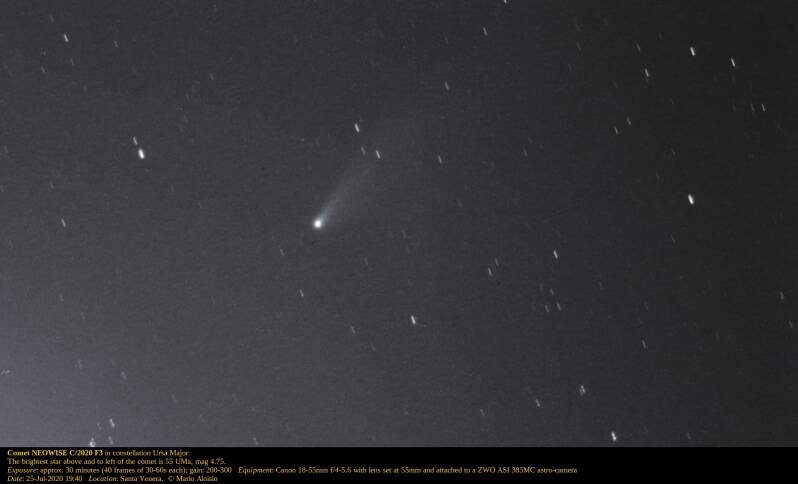
Comet C/2020 F3 NEOWISE in constellation Ursa Major
Exposure: 30 minutes (40 frames of 30-60s each); gain: 200-300; stacked with DSS Equipment: Canon 18-55mm f/4-5.6 with lens set at 55mm and attached to a ZWO ASI385MC astrocamera
Date: 25-July-2020 18:45 UCT Location: Santa Venera. © Mario Aloisio
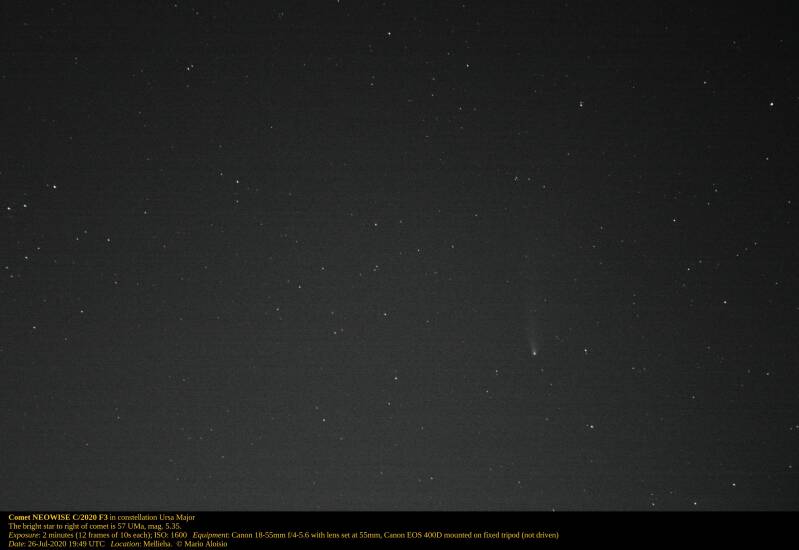
Comet C/2020 F3 NEOWISE in constellation Ursa Major
Exposure: 2 minutes (12 frames of 10s each); ISO 1600; stacked with DSS
Equipment: Canon 18-55mm f/4-5.6 with lens set at 55mm and mounted on a
Canon Rebel 400D; camera mounted on fixed tripod.
Date: 26-July-2020 Location: Mellieha
© Mario Aloisio
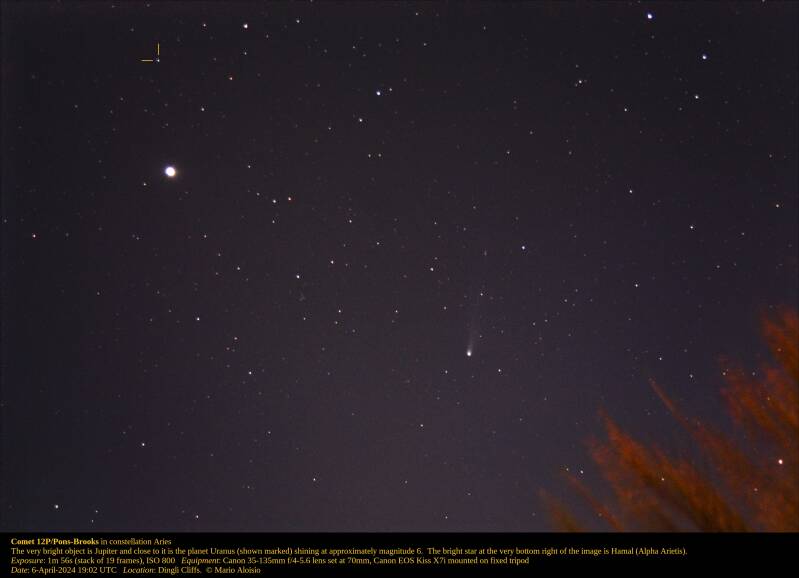
Comet 12P/Pons-Brooks in constellation Aries
The very bright object is Jupiter and close to it is the planet Uranus (shown marked) shining at approximately magnitude 6. The bright star at the very bottom right of the image is Hamal (Alpha Arietis).
Exposure: 1m 56s (stack of 19 frames), ISO 800 Equipment: Canon 35-135mm f/4-5.6 lens set at 70mm, Canon EOS Kiss X7i mounted on fixed tripod.
Date: 6-April-2024 19:02 UTC Location: Dingli Cliffs. © Mario Aloisio
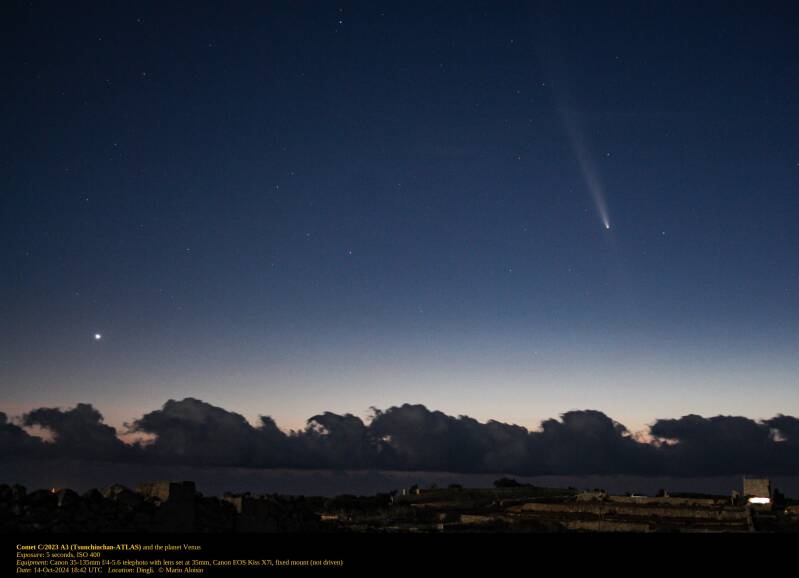
Comet C/2023 A3 (Tsunchinchan-ATLAS) and the planet Venus
Exposure: 5 seconds, ISO 400
Equipment: Canon 35-135mm f/4-5.6 telephoto with lens set at 35mm, Canon EOS Kiss X7i, fixed mount (not driven)
Date: 14-Oct-2024 18:42 UTC Location: Dingli. © Mario Aloisio
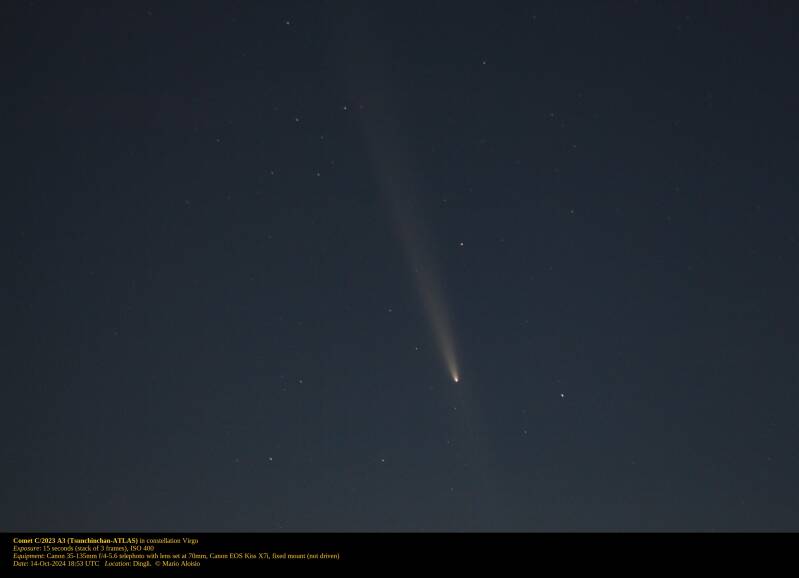
Comet C/2023 A3 (Tsunchinchan-ATLAS) in constellation Virgo
Exposure: 15 seconds (stack of 3 frames), ISO 400
Equipment: Canon 35-135mm f/4-5.6 telephoto with lens set at 70mm, Canon EOS Kiss X7i, fixed mount (not driven)
Date: 14-Oct-2024 18:53 UTC Location: Dingli. © Mario Aloisio
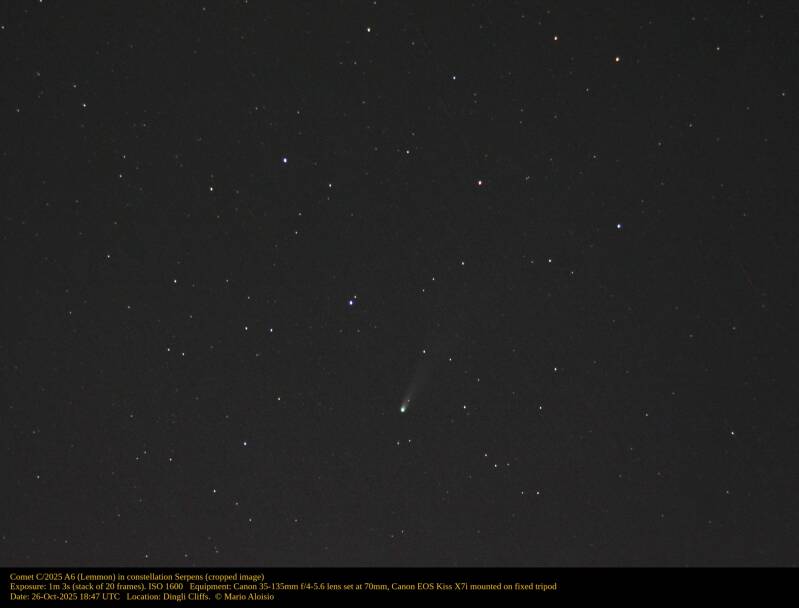
Comet C/2025 A6 (Lemmon) in constellation Serpens (cropped image)
Exposure: 1m 3s (stack of 20 frames). ISO 1600 Equipment: Canon 35-135mm f/4-5.6 lens set at 70mm, Canon EOS Kiss X7i mounted on fixed tripod
Date: 26-Oct-2025 18:47 UTC Location: Dingli Cliffs. © Mario Aloisio
Create Your Own Website With Webador