Nebulae
Nebulae are divided into various types and sub-types: diffuse, planetary, emission, dark, and reflection nebulae.
So-called planetary nebulae have nothing to do with planets; they are named like this because a number of these nebulae somewhat resemble planets when observed through a telescope. A planetary nebula is formed when an evolving star gently sheds a shell of gas. Often, the evolving star may be seen at the centre of the nebula (as with the Helix Nebula in Aquarius and the Ring Nebula in Lyra).
Similar nebulae may be formed after massive stars explode as supernovae, ejecting into space heavy elements formed within them. Such nebulae are known as supernova remnants (the Crab Nebula in Taurus and the Veil Nebula in Cygnus being two examples).
Emission nebulae are regions where stars are often formed (created). In an emission nebula ultraviolet light from stars within the nebula is absorbed and re-emitted at visible wavelengths. Long exposure photographs often show the beautiful colours of the glowing hydrogen gas. The Great Orion Nebula is probably one of the best examples of such nebulae. Note that planetary nebulae may also be considered as types of emission nebulae when they consist of an expanding, glowing shell of ionized gas that has been ejected from red giant stars late in their lives.
The large amount of gas and dust that exists within the Galaxy is commonly concentrated into the dense ‘clouds’ we refer to as nebulae. When thick masses of dust block the light from distant stars forming a conspicuous ‘silhouette’ shape against a brighter background, we end up with so-called dark nebulae. The Horsehead Nebulae in Orion is a fine example.
In a reflection nebula, clouds of dust reflect light from hot, young stars lying in front of them. Gas may also be present but it is only in a few cases that the stars within them provide sufficient energy to make the gas glow. Long exposure photographs of the Pleiades, for example, show these reflection nebulae withing them.
Following are a selection of images of nebulae taken over a span of several years.
The Dumbbell Nebula (M27) in constellation Vulpecula
Exposure: 8 mins (48 frames of 10s each); gain 250 Equipment: Sky-Watcher 150mm f/5 Newtonian, ZWO ASI385MC, prime focus
Date: 11-Jul-2020 21:30 UTC Location: Santa Venera. © Mario Aloisio
The Dumbbell Nebula is an example of a planetary/emission nebula situated at approximately 1360 light-years. Charles Messier is credited to have first discovered it in 1764. With an apparent visual magnitude of about 7.5 and an angular diameter of about 8 arcminutes, it is easily visible in a small telescope.

A wide-field image of the Dumbbell Nebula (M27) in constellation Vulpecula
Exposure: 1m 20s (8 frames of 10s each), ISO 400 Equipment: Sigma 300mm f/4 APO telephoto lens attached to a Canon EOS 5D Mark II
Date: 20-Oct-2020 19:25 UTC Location: Santa Venera. © Mario Aloisio

The Rosette Nebula in constellation Monoceros
Exposure: 27 minutes (stack of 41 frames) Equipment: Vivitar 200mm f/3.5 lens set at f/5.6 and attached to a ZWO ASI585MC camera
Date: 6-Feb-2024 20:14 UTC Location: Santa Venera. © Mario Aloisio
The Rosette Nebulae (NGC 2237) is a massive, star-forming region, a glowing red cloud of hydrogen gas about 100 light-years in diameter. At the centre of this nebula is a star cluster (NGC 2244 or Caldwell 50), easily identifiable through binoculars. The distance of the Rosette Nebula is about 5200 light-years. Angular diameter is about 1.3 degrees, and visual magnitude about 9. The Rosette Nebula is an example of an emission nebula (H II—ionized hydrogen— region).

The Great Orion Nebula (M42)
Exposure: 2m 10s (stack of 7 frames), ISO 800 Equipment: Celestron 203mm f/5 Newtonian, Canon EOS Kiss x7i (700D)
Date: 26-Jan-2022 18:41 UTC Location: Santa Venera. © Mario Aloisio
The Orion Nebula is one of the brightest in the sky, easily visible with the naked eye from dark sites. It is a place where stars and planetary systems are being formed. It is an example of a diffuse/reflection/emission nebula. Distance: ca. 1340 light-years.

The Great Orion Nebula (M42)
Exposure: 14 minutes (stack of 37 frames) Equipment: Tamron AF70-300mm f/4-5.6 with lens set at 135mm and attached to ZWO ASI385MC
Date: 9-Feb-2022 21:32 UTC (Note: The moon was at first quarter.) Location: Santa Venera. © Mario Aloisio
This is an image taken with an astro-camera attached to a telephoto lens.

The Flame and Horsehead Nebulae in constellation Orion
Exposure: 18 minutes (stack of 28 frames) Equipment: Vivitar 200mm f/3.5 lens set at f/5.6 and attached to a ZWO ASI585MC camera
Date: 6-Feb-2024 18:01 UTC Location: Santa Venera. © Mario Aloisio

The Horsehead Nebula in constellation Orion
This is a closer view through a telescope.
Exposure: approx. 16 mins (47 frames); gain 250 Equipment: Sky-Watcher 150mm f/5 Newtonian, ZWO ASI385MC, prime focus
Date: 22-Feb-2023 18:40 UTC Location: Santa Venera. © Mario Aloisio

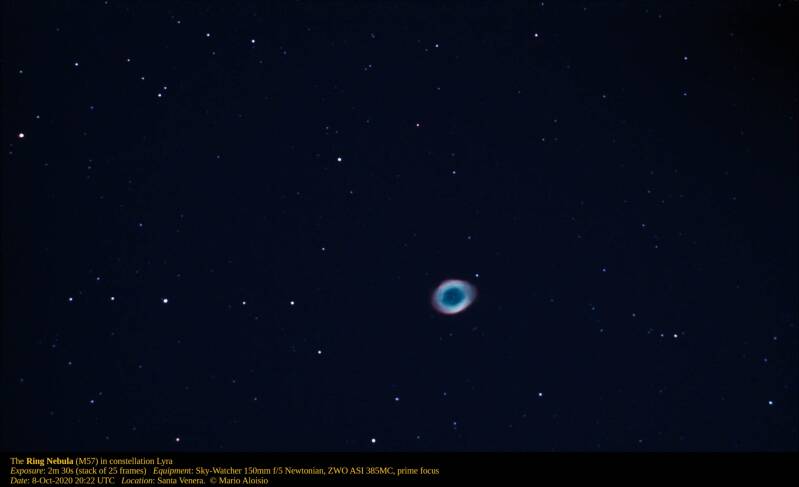
The Ring Nebula in constellation Lyra
This nebula was discovered by Charles Messier in 1779 and given the designation M57 (the 57th ‘Messier’ object catalogued by him). It is an example of an emission/planetary nebula, with the central faint star (approximately magnitude 15) from which the material was expelled being just about visible in this image. The nebula is situated 2570 light-years away.
Exposure: 2m 30s (stack of 25 frames) Equipment: Sky-Watcher 150mm f/5 Newtonian, ZWO ASI 385MC, prime focus
Date: 8-Oct-2020 20:22 UTC Location: Santa Venera. © Mario Aloisio
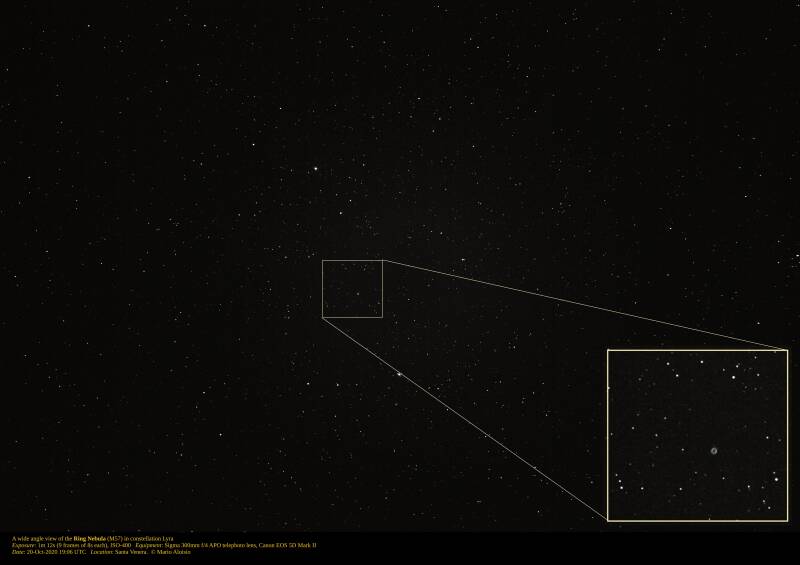
A wide angle view of the Ring Nebula (M57) in constellation Lyra
Exposure: 1m 12s (9 frames of 8s each), ISO-400
Equipment: Sigma 300mm f/4 APO telephoto lens, Canon EOS 5D Mark II
Date: 20-Oct-2020 19:06 UTC Location: Santa Venera. © Mario Aloisio
Create Your Own Website With Webador