Galaxies
The Andromeda Galaxy (M31)
Exposure: 14m 15s (35 frames of 25s each), gain 280-320 Equipment: Sigma 300mm f/4 APO telephoto lens attached to ZWO ASI385MC camera Date: 14-Nov-2020 18:14 UT Location: Santa Venera. © Mario Aloisio
The Andromeda Galaxy is the nearest large galaxy to us, even though it is about 2.5 million light-years away. It is estimated to contain roughly one trillion (million million) stars, and it is so great that light needs around 200,000 years to travel from one end of this galaxy to the other. It is roughly twice the size of our own galaxy. From a dark site it can be seen with the naked eye.

A wide-angle view of M31 (the Andromeda Galaxy), M32 and M110
Exposure: 10m 42s (stack of 30 frames) Equipment: Sigma 300mm f/4 APO telephoto lens, Canon EOS Kiss X7i
Date: 2-March-2022 18:30 UTC Location: Santa Venera. © Mario Aloisio

A close-up of the Andromeda Galaxy (M31)
Exposure: 15 minutes (stack of 37 frames) Equipment: Sky-Watcher 150mm f/5 Newtonian, ZWO ASI385MC, prime focus
Date: 31-Oct-2022 19:30 UTC Location: Santa Venera. © Mario Aloisio

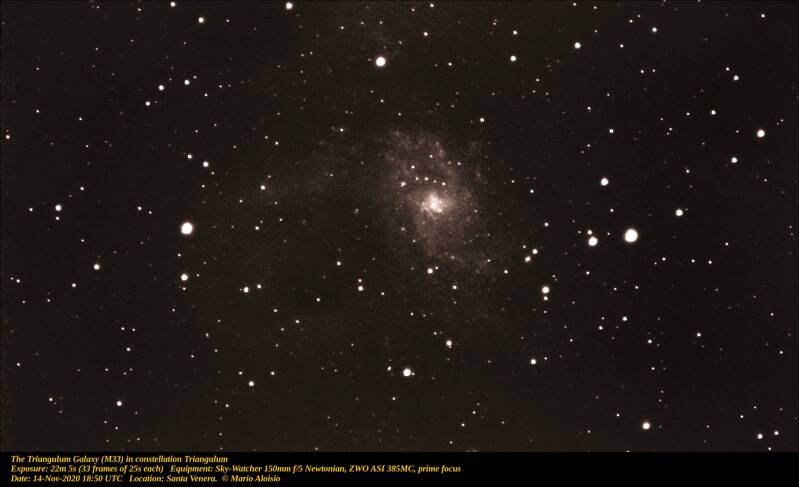
The Triangulum Galaxy (M33) in constellation Triangulum Exposure: 22m 5s (33 frames of 25s each) Equipment: Sky-Watcher 150mm f/5 Newtonian, ZWO ASI 385MC, prime focus
Date: 14-Nov-2020 18:50 UTC Location: Santa Venera. © Mario Aloisio
This galaxy forms part of the so-called Local Group of galaxies. The local group is a collection of relatively nearby galaxies that include our own Milky Way galaxy and the famous Andromeda Galaxy. M33’s distance from us is approximately 2.9 million light years.
The dwarf galaxy NGC 5474 in constellation Ursa Major
Exposure: approximately 15 minutes (stack of 48 frames) Equipment: Omegon 203mm f/4 Newtonian, Starizona Nexus 0.75x coma corrector, ZWO ASI385MC
Date: 8-June-2023 22:30 UTC Location: Santa Venera. © Mario Aloisio

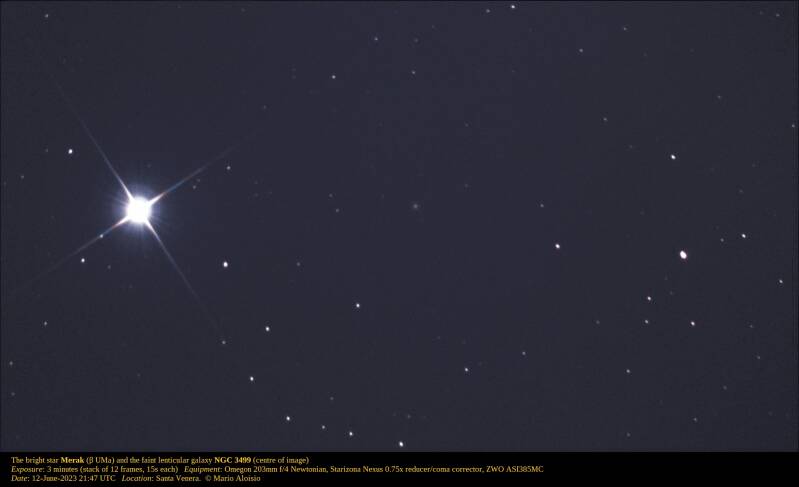
The bright star Merak (β UMa) and the faint lenticular galaxy NGC 3499 (centre of image)
Exposure: 3 minutes (stack of 12 frames, 15s each) Equipment: Omegon 203mm f/4 Newtonian, Starizona Nexus 0.75x reducer/coma corrector, ZWO ASI385MC
Date: 12-June-2023 21:47 UTC Location: Santa Venera. © Mario Aloisio
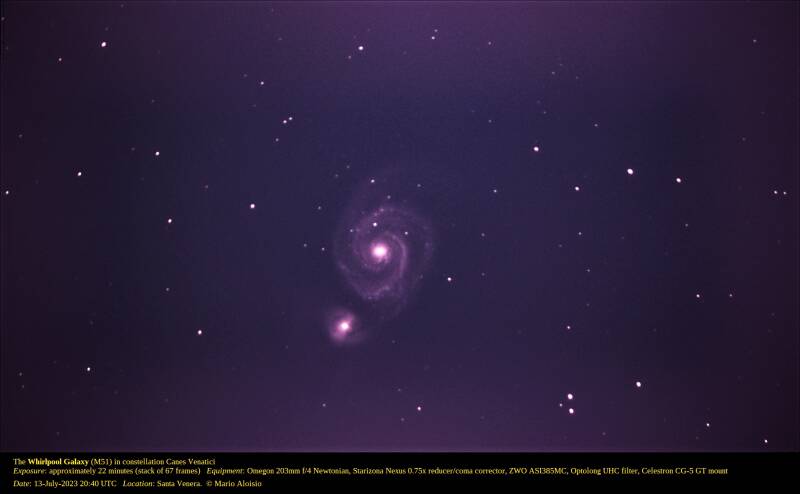
The Whirlpool Galaxy (M51) in constellation Canes Venatici
Exposure: approximately 22 minutes (stack of 67 frames) Equipment: Omegon 203mm f/4 Newtonian, Starizona Nexus 0.75x reducer/coma corrector, ZWO ASI385MC, Optolong UHC filter, Celestron CG-5 GT mount
Date: 13-July-2023 20:40 UTC Location: Santa Venera. © Mario Aloisio
Create Your Own Website With Webador